Meshell Ndegeocello Please Dont Tempt My Heart Again
The acclaimed bassist rebuilds a set of cover songs on her latest album, Ventriloquism, while focusing on her personal connexion to archetype soul and R&B;, and creating plenty of room for all-star guitar contributions.
Meshell Ndegeocello believes people connect with the about essential elements of songs: melodic hooks, words, rhythms. This utilitarian mindset is a big part of what makes up Ndegeocello's signature sound as both a songwriter and as a player. Whether recording her ain compositions, taking on cover textile, collaborating with other musicians, or doing studio work, she consistently follows her ain artistic vision.
As an accomplished collaborator and session artist, she'due south worked with big-name artists beyond genres, including Herbie Hancock, Madonna, Chaka Khan, and the Rolling Stones, and has brought her personal affect to those sessions with the same gusto she delivers in her ain piece of work. Her bass tone and playing style is instantly recognizable, likely due in some role to her no-frills mental attitude almost gear. "I learned early because I was poor," she told Premier Guitar during our interview. "You can't have whatsoever excuses. You lot play well and the tone is in your hands."
Over the course of the concluding 2 and a half decades, Ndegeocello has been a prolific songwriter, from her start release—1993's Plantation Lullabies, which featured the unmarried "If That'southward Your Beau (He Wasn't Final Night)"—through 2014's Comet, Come to Me. She'south as well explored cover material throughout her career, including 1-off tracks like her 1994 collaboration with John Mellencamp (a version of Van Morrison's "Wild Night") and tribute albums such every bit her 2012 record, Cascade une Âme Souveraine: A Dedication to Nina Simone.
On her newest tape, Ventriloquism, Ndegeocello takes the essential elements of songs popularized by artists such as Prince, Sade, George Clinton, Tina Turner, Janet Jackson, and TLC, and rebuilds them in her own musical vocalisation. But the bassist is non willing to take all of the credit. She'south quick to mention that "Meshell Ndegeocello is a band," and that her bandmates are a part of the creative process. In addition to her long-time collaborators in Chris Bruce on guitar, drummer Abe Rounds, and Jebin Bruni on keys, Ndegecello likewise called on a few hot-shot guitarists to contribute, including Adam Levy, Jeff Parker, and Doyle Bramhall II.
During our phone interview, Ndegeocello chatted about Ventriloquism and her longtime career as an creative person, but besides took some time to talk about making albums, whether at that place is notwithstanding room for mistakes on records, and the value of honest performances.
Throughout your career, you lot've done quite a few covers. Ventriloquism features a range of covers filtered through your ain musical lens. How did yous choose your material?
On this i, I simply chose the songs I similar. I chose songs from my childhood. I had a lot of help with this from friends, just talking almost this record. My begetter died, so I would get home and in that location was a certain station and they would play old songs, from my teenage years. "Tender Love" [past Force MDs] sort of sparked the conversation.
That was the first 1 you chose?
Yep, and and so that turned dinner conversations into, "I retrieve where I was when that vocal came out." "I Wonder If I Take You Home" was the 2d one that started to broadcast in my listen, and then I was in the car one day and I heard "Nite and Twenty-four hour period." That but led me on the journey to the songs I really dug from that part of my life. I love "Sensitivity" and "Tender Love" and "Funny How Time Flies," then I realized they were all written by Terry Lewisand Jimmy Jam. I just started to weave something together where I couldn't explicate what I'd hear or see as the outcome, but simply effort to pick the ones that felt practiced—that felt true to who I was and the R&B that I dug.
"I learned early because I was poor: You lot tin't have whatever excuses. Yous play well and the tone is in your hands."
I always loved "Private Dancer," considering it'due south written by Marking Knopfler and that was from that moment in time where there was a lot of songwriting coming from artists who had hits. I miss that period. There were all these niggling sleeper tunes, similar all the tunes Prince wrote, for the Bangles and stuff like that. Now I'g wondering how many songs Ed Sheeran has written for modern artists right at present that you don't know about.
When a song speaks to y'all, how practice you lot find the right arrangement and what kind of decisions do you brand with the band?
This tape was washed totally as a ring. Usually the takes are second and tertiary takes, just nosotros ran through them for a couple of days but to see which ones felt right and where we could reconfigure them in different means. On "Shine Operator," nosotros tried doing it like it was, approaching it from the same place. It's such a proficient song, you can't set up what'south not broken. So, nosotros were like, "Just throw it away."
I have this belief, now, that a song is just the lyric, the tune, and the trounce. I feel similar those are the things that connect with the people. So, the drummer had this groove, and we just threw away all the other stuff and I just maintained the tune and put it in 5. Just to do something dissimilar. To me music is audible collage and I'm but trying to make all the colors and shapes work.

TIDBIT: "My brother played guitar. I just take a serious analogousness for it," says Meshell Ndegeocello. In addition to longtime guitarist Chris Bruce, she brought in hot-shot guitarists Doyle Bramhall II, Adam Levy, and Jeff Parker to add together 6-string colors to Ventriloquism.
How about production decisions, things like that?
That only comes in a real fluid way. We just all work together to figure out what works and doesn't work. It was produced by the keyboard histrion, Jebin [Bruni], who made a lot of the harmonic and colour texture choices.
When I get to L.A., the tape that's the soundtrack to my life is Harvest by Neil Young. That's the record I listen to when I roll downwards the street. I remember asking Chris Bruce, the guitar thespian, "'Tender Dearest'—can you lot brand it sound like Harvest?" So, he'll zap into those ideas and arrange the guitar part.
I've been told that I gotta check out Chris Bruce. You've worked together for a while, right?
I met him making [1999's] Bitter. When I was making that record, I worked with my really good friend [producer] Craig Street, who'southward produced a lot of actually amazing records, and he simply persuaded me to trust him and he brought in all new people. Abe Laboriel, Doyle Bramhall II, Wendy [Melvoin] & Lisa [Coleman] are on Biting, and Chris Bruce played a lot of the guitar on Bitter. And that was just the outset.
You lot know how people say brother from some other mother? That's what information technology was similar. I felt similar I met my cosmic friend. He's merely a top-shelf thespian. He plays all styles. He's played with Seal, he'due south played with Wendy & Lisa, Sheryl Crow, Aimee Isle of man. You've probably heard his work only yous don't know it's him. He's that kind of session guy, but he'due south also probably the world'south greatest DJ because he listens to such a range of music. He's the person that's got me into Wire and Mark E. Smith and the Fall. He'south the person that's just shown me in that location'southward so many other ways to express yourself.
As a thespian, he has 1 of the cleanest, best tones. That'due south what separates him. I've played with a lot of guitar players—a lot of famous people that people dearest and I've played in the studio with them and I've seen the magic. But I've played with those super famous people live and their tone is not as developed in the live sense as it is in the studio. Chris Bruce, his tone live, it brings y'all to tears. It's warm, it's fat, he doesn't noodle, his pocket is incredible. I can't say enough about him. He's simply a super-gifted musician who happens to play the guitar well.
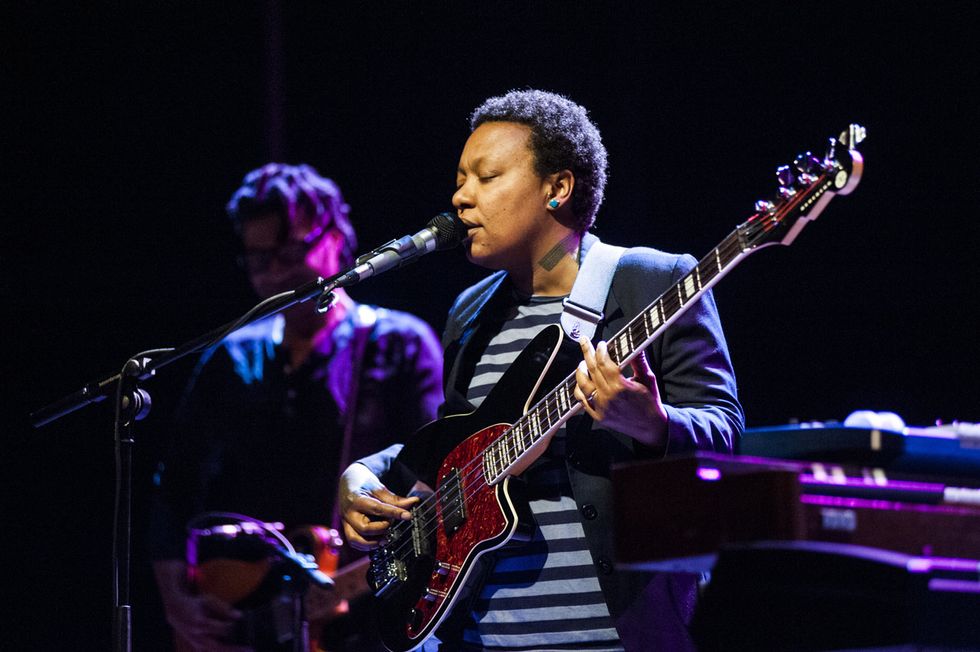
Reverend Guitars and Meshell Ndegeocello collaborated on her signature Fellowship bass model. She also favors Fender Jazz basses and has a 1963 and a 1974 model in her rotation. Photograph by Jordi Vidal
In that location are lots of actually great guitar moments on the record.
I've got two other guitar masters. Adam Levy plays the electric on "Sensitivity," and he'south incredible on there. And I as well have Jeff Parker on "Don't Disturb This Groove" and "Smooth Operator"—he'southward astounding. They're both amazing. And then the guy doing the narration on "Smooth Operator" is Eric Schermerhorn, who played with Iggy Pop. It's like, I'm surrounded by amazing guitar gods in my world. My brother played guitar. I just accept a serious analogousness for it.
There's some really great guitar work on "Diminutive Domestic dog."
I forgot the other guitar god on there: that'southward Doyle Bramhall! Chris plays all the audio-visual and the layering of colors and then the solo stuff, and that's Doyle. He's like my hero. I can't sing his praises enough—he'south a tone giant. He's playing the blues and across; he'due south interstellar with his playing.
You mentioned your brother is a guitar actor. Did you pick upward a bass merely to play or to write songs?
I'one thousand glad you asked that—it was songwriting. I picked up the bass because my brother's friend left it and it allowed me to play with my blood brother. Then my begetter, he was ane of those pawn-store goers, he would merely find stuff. He found a iv-rail tape recorder and he bought a Rhodes and at that fourth dimension I realized I was more into the songwriting than I was into existence a virtuoso.
So, did yous get-go playing that keyboard first?
No, I had the bass. I played them simultaneously. I played the clarinet first and I was like, "Whoa, this is difficult." At that place wasn't a lot I could do. I hadn't heard Don Byron still. If I'd heard Don Byron, I might be a clarinet role player. I didn't take access to any of that yet.
How old were you when y'all picked upwardly the bass?
Fourteen or xv.
"To me music is audible collage and I'm just trying to make all the colors and shapes work."
Something interesting about your career is that you lot're known in a couple different roles. Yous've got your own music but y'all're as well featured every bit a bass player on some heavy sessions, playing with artists like Herbie Hancock, the Rolling Stones, and Madonna. What role does that fulfill for you lot creatively? What has your experience been similar as a session player?
Information technology's completely split. I love playing the bass. I've been hired to play the bass, but too, I accept such a distinctive manner, it doesn't work for everybody, like, I tin't play bluegrass—I play too far laid back in the beat and it drives the drummer crazy. I would love to play country stuff; I would beloved that. I like playing bass because it shapes the music. I can really lock downwardly on bass, brand it groove, and not play too much.
On some sessions, I become and just play the bass part. They have the chords and they have where it bounces and I only practice what they say and those people are more interested in my name or my tone. They're non looking for my inventiveness. Then there are some people that give you something and say "practise whatever yous want." And that'south cool, too. But I stopped doing that, in a way, because then you lot exercise what you want and they don't like information technology. That's weird. Then there'due south collaborative things where you go and you're actually there with the person and they want yous to bring your A game with your inventiveness in the sense of creating something together and I actually relish that.
I did a session with Allen Toussaint i time, and he and I were the band. Nosotros played and, to me, information technology was incredible. He laid down i of the about amazing tracks I always heard and the person was similar, "Tin you practise one more than take?" We did one more than take so the person came in and was like, "Could you lot do this?" And Allen was like, "No, no I can't." That really blew my mind. He said, "No, what'southward wrong with information technology? If you lot can tell me what'south wrong with it, I'll do it once again." I recollect Pro Tools has opened upwards this thing of just, similar, endless tracks. Information technology becomes an countless do of someone else'south imagination.

Basses
Reverend Meshell Ndegeocello Fellowship Bass
1963 Fender Jazz Bass
1974 Fender Jazz Bass
Amps
Aguilar Tone Hammer 500
Aguilar DB 212 cabinet
Effects
3Leaf Audio Octabvre
3Leaf Audio Wonderlove Envelope Filter
Malekko B:assmaster
TC Electronic Flashback Delay

And in that location's ever something else to be perfected or something. There'southward option anxiety.
I heed to records now and they're and so perfected. I feel like I'thou missing something. I tin't wait to get back to where, for example, the drummer and I sing a lot together, and we're but gonna sing until nosotros get information technology right.
When you lot recorded Ventriloquism, how did you arroyo it the studio?
Nosotros record like we're going to record and so we mind to information technology, find the best have, and fix if there are issues with it, or nosotros don't prepare and we build on top and omit. Omit is a production affair that people might need to get attached to.
Practise you think in that location is still a place for mistakes on records in 2018?
Oh god, I miss those! I miss those so much!
In that location are some noticeable mistakes on archetype records. For instance, on Bob Dylan's Blonde on Blonde, the bass player on "Visions of Johanna" makes a mistake with the class. It'due south a big mistake on a big record and it'southward there to exist heard.
One of my favorites is Stevie Wonder, "I Believe (When I Fall in Love)." I swear y'all can hear him fall off the drum set. He loses like a whole beat out and a half in it, like something was going wrong.
There's a and then-called mistake in "Funny How Fourth dimension Flies." I go to the chorus tardily and Abe [Rounds, drummer] totally crashes on it. Afterwards a while, I liked information technology. Nosotros take a lot of those. I made records when you lot got a lot of money and I've made records where there was piddling coin. That'southward something else Chris Bruce has taught me. Sure, we all want to achieve perfection, simply sometimes there'southward these human things that happen in there that seem similar failures or faux pas, but it's like women. I don't hateful to audio weird, but a really beautiful woman is a piddling wonky. At that place'due south something there that'due south not so-called perfect. Information technology'south like how the bananas with the niggling brown blemishes are ripe and more than flavorful.
I could think of three other Bob Dylan tunes if I tried hard that have weird things. Or Parliament-Funkadelic records—oh my god, not perfect! A lot of funk records … Ohio Players. Non perfect. And I retrieve that's cute.
You mentioned Neil Young'south Harvest. Neil is nonetheless putting mistakes all over his records.
Yep! I wanna go back to the melody, the lyric, and the trounce. The drummer, Kenny Buttrey, as long every bit him and Neil are together, information technology'south all good. Information technology's like the menstruum of those two musicians make everything else and so it just sits and settles in a style that's amazing. There's definitely imperfection in that. I've seen him play live and he's just banging on the guitar, and rumbling, and the overtones are coming out. I just saw Marc Ribot play with David Hidalgo from Los Lobos. Information technology's amazing. If they had so-called mistakes, it just led those ii men into different waters. I think people were hoping that they'd brand so-called mistakes because it would simply lead them to this other place.
Unplanned territory.
Unplanned territory is where, with a virtuosic musician especially, you become the most amazing things. I'yard sure no one was telling Coltrane and Elvin Jones, "I don't know if that'southward correct."
I must acknowledge, I had a really bad bear witness recently. The pianoforte histrion forgot a song, I sung some clunkers, but later the show, everyone loved it. When you're playing for people and not musicians, they desire something else from you. I hate to sound corny, simply the give-and-take I would grasp for is sincerity. If I pay $l to go encounter you, I at least want you lot to exist honest. Especially with certain musicians: I already know you're a genius, I already know yous can play.
YouTube Information technology
In this operation, Ndegeocello and her ring put their stamp on Nick Drake's classic ballad "Pink Moon." They preserve Drake's lush and subdued sound while shaping the vocal past orchestrating his melodic lines among their instrumentation. Ndegeocello'due south signature bass tone and style are instantly recognizable even when playing this song's elementary figures.
Source: https://www.premierguitar.com/artists/meshell-ndegeocello-the-melody-the-lyric-and-the-beat
0 Response to "Meshell Ndegeocello Please Dont Tempt My Heart Again"
Postar um comentário